Why Clean Healthcare Environments Can Still Pose Infection Risks
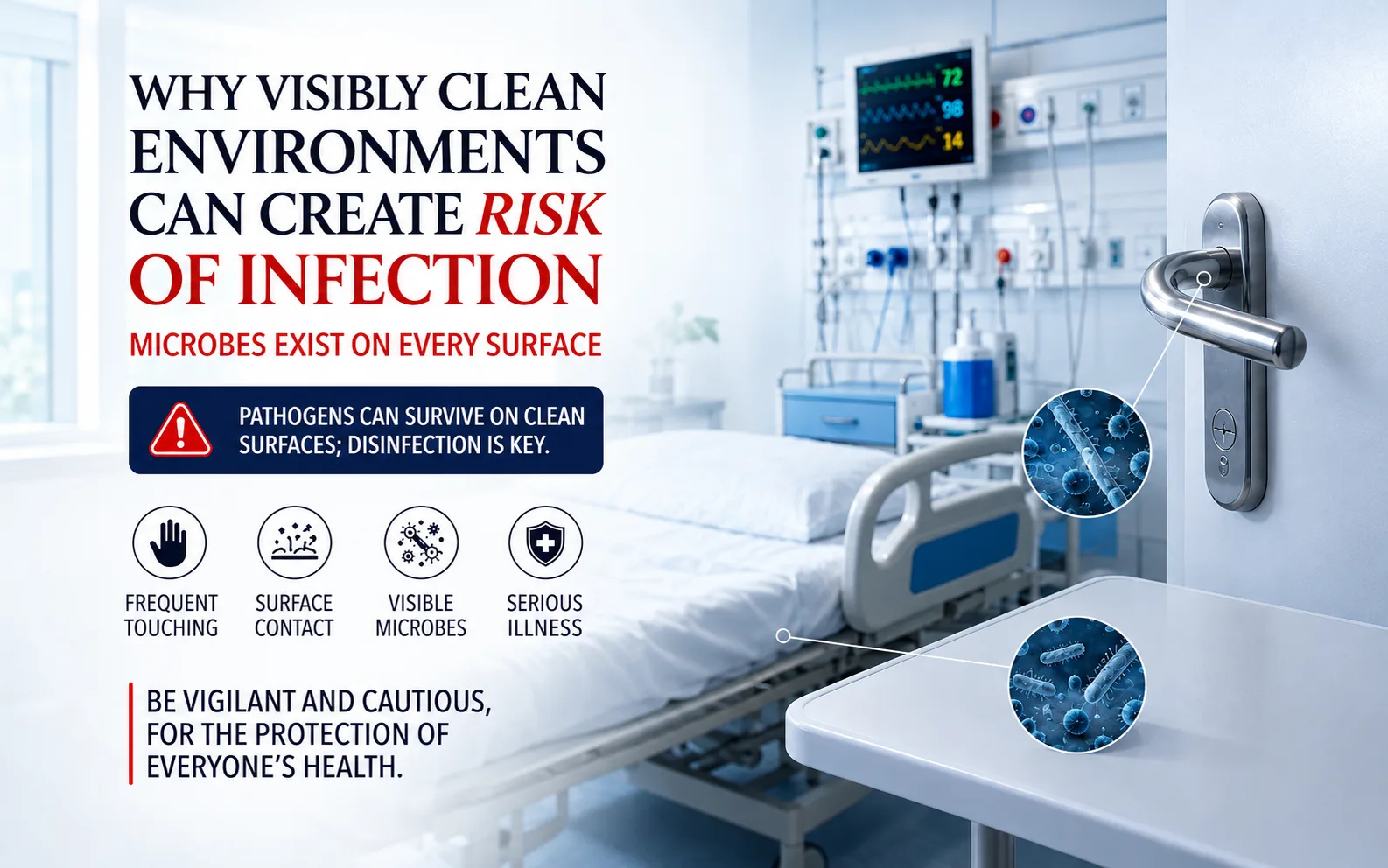
In many healthcare facilities, “cleanliness” is still judged primarily by appearance. If surfaces are shiny, floors appear free of contamination, and equipment is neatly arranged, it is easy to assume that infection risk is also being properly controlled.
The problem is that many contamination risks develop precisely in environments that appear completely acceptable at first glance. The reason is simple: infection prevention does not depend on cleanliness alone. Daily workflow, how equipment is transported and stored, communication between staff, and operational consistency all play a role in actually reducing contamination risk.
In busy healthcare environments, small gaps can gradually become routine practices. Each one may seem insignificant on its own, but together they can quietly weaken the infection prevention system.
Small Shortcuts Gradually Become Routine Practices
One of the most common problems in healthcare environments is not the complete breakdown of a procedure, but gradual inconsistency. Staff work under pressure, priorities change quickly, and they naturally look for ways to move tasks forward more efficiently. Over time, these small shortcuts can become embedded in everyday practices without any conscious decision to change the process.
This may take the form of temporarily storing equipment in an inappropriate location, allowing clean and used items to cross paths during busy periods, or handling materials differently depending on workload and staffing levels.
The key point is that contamination risk is rarely the result of one major mistake. Instead, it is usually the result of repeated small inconsistencies that gradually reduce the reliability of the infection prevention system.
Because these habits develop slowly, they can be difficult to recognize from within the organization. A temporary solution can quickly become the “usual way of doing things,” especially when no one has clearly assigned responsibility for periodically reviewing the process.
Shared Equipment Creates Avoidable High-Risk Points
Another issue that often affects infection prevention is how shared equipment is transported and used. Items such as carts and trolleys, transport containers, and reusable equipment move between departments and different areas of care throughout the day.
Even when cleaning procedures are technically performed correctly, inconsistencies in how equipment is transported can still create contamination risks.
For example, equipment may temporarily be placed in an inappropriate location, separation between clean and contaminated items may be inadequate, or items may be moved between clean and potentially contaminated areas without sufficient attention to workflow.
These are usually not dramatic failures. Instead, they are operational habits that quietly develop in fast-paced environments.
The main challenge for organizations is that a piece of equipment may appear completely clean, but if the process used to transport and store it is inconsistent, contamination risk may still remain.
This becomes particularly important when equipment is shared among multiple teams or departments. If it is unclear who is responsible for cleaning, maintaining, or checking the equipment between uses, standards can gradually decline without anyone intentionally disregarding the procedure.
Staffing Shortages Affect Operational Consistency
Healthcare facilities have faced considerable pressure from workforce shortages in recent years, and infection prevention is not separate from these challenges.
When staffing is limited, maintaining consistency becomes more difficult. Cleaning schedules may still be followed on paper, but the finer details that actually support infection prevention can be difficult to maintain consistently every day.
New or temporary staff may not be fully familiar with established procedures. Communication between teams can become less coordinated during busy periods, and responsibilities that once seemed clear can gradually become ambiguous.
This does not mean that staff are failing to do their jobs. In many cases, teams work extremely hard under difficult operational conditions.
However, infection prevention depends heavily on consistency, and maintaining that consistency becomes much more difficult as operational pressure increases.
For this reason, infection prevention systems should be designed realistically. A process that works only when staffing levels are optimal and everyone has enough time to perform every step precisely is unlikely to remain sustainable during periods of high operational pressure.
Communication Gaps Often Create Hidden Risks
Infection control failures are often viewed simply as cleaning problems, while communication issues can also play an important role.
If staff do not know whether a piece of equipment has been cleaned, whether an environment is ready for use, or whether a temporary storage arrangement has been approved, these small uncertainties can lead to inconsistent decisions.
These gaps are particularly common when several teams are responsible for a shared environment. Environmental services staff, clinical personnel, facilities teams, and external contractors may all work with the same spaces and equipment.
If responsibilities are not clearly defined, each team may assume that another team has already addressed the issue. This is how risk can remain hidden within an apparently clean environment without anyone realizing it.
The solution is not always complicated. Clear handoffs between shifts, simple reporting pathways, and clearly assigned ownership of shared equipment can make a significant difference.
The goal is to reduce the number of assumptions that staff have to make throughout the working day.
Written Procedures Do Not Always Reflect Reality
Most organizations have policies covering cleaning, segregation, transportation, and infection prevention. The problem is that written procedures do not always correspond to the reality of a busy working environment.
Processes that appear simple on paper can become much more difficult during periods of peak workload or staff shortages. Teams may informally modify procedures to keep work moving, even if those changes have never been formally reviewed or approved.
Over time, this can lead managers to believe that procedures are being followed consistently, while day-to-day practice has gradually moved away from the original process.
This is one reason why visible cleanliness can sometimes create false reassurance. An environment may appear clean while underlying inconsistencies continue to increase risk.
Regular review of procedures should also involve asking staff how the process is actually carried out in practice. If there is a difference between the documented process and the actual process, that gap requires attention.
Audits Should Look Beyond Appearance
Cleaning audits often focus on visual standards, completion of schedules, and final approval of specific areas. These checks are useful, but they do not always show how contamination may move through an environment.
A space may pass a visual inspection while still having poor separation between clean and used items, unclear equipment storage, weak handoff processes, or unclear responsibility for shared resources.
For this reason, infection prevention audits should also consider workflow, transportation, and staff behavior.
Questions such as:
“Where does this item go next?”
“Who checks it between uses?”
“How do staff know that this task has been completed?”
can reveal risks that are not visible from appearance alone.
The goal is not to make audits more complicated for the sake of complexity. The goal is to make audits genuinely reflect how the environment is actually used.
Successful Organizations Focus on Operational Transparency
Healthcare facilities that manage infection prevention more effectively generally do not rely solely on cleaning frequency or visual standards. Instead, they focus strongly on operational transparency and consistency.
This approach often includes regularly reviewing workflows, encouraging staff to report operational concerns early, monitoring how procedures are actually performed, and identifying points where practices begin to deviate.
Importantly, these organizations recognize that infection prevention is not solely the responsibility of the cleaning team. It depends on the interaction of multiple departments, workgroups, and operational processes throughout the day.
Where organizations maintain strong communication, clearer accountability, and greater transparency around everyday processes, infection prevention systems also tend to remain more stable.
Infection Prevention Depends on Systems, Not Appearance
Cleanliness will always remain an important part of infection prevention. However, visible cleanliness alone does not mean that contamination risk is being properly controlled.
In many cases, the greatest infection control risks arise from inconsistent workflows, inappropriate transportation practices, communication gaps, and operational habits that gradually become routine.
For healthcare facilities, reducing these risks often depends less on introducing entirely new cleaning procedures and more on maintaining strong operational consistency around existing systems.
When infection prevention is viewed as an operational process rather than simply a cleaning responsibility, it becomes much easier to identify the small gaps that could later develop into larger problems.
Original Source: Infection Control Today, “Why Visibly Clean Environments Can Still Create Infection Risks,” by Brodie Cook, July 24, 2026.