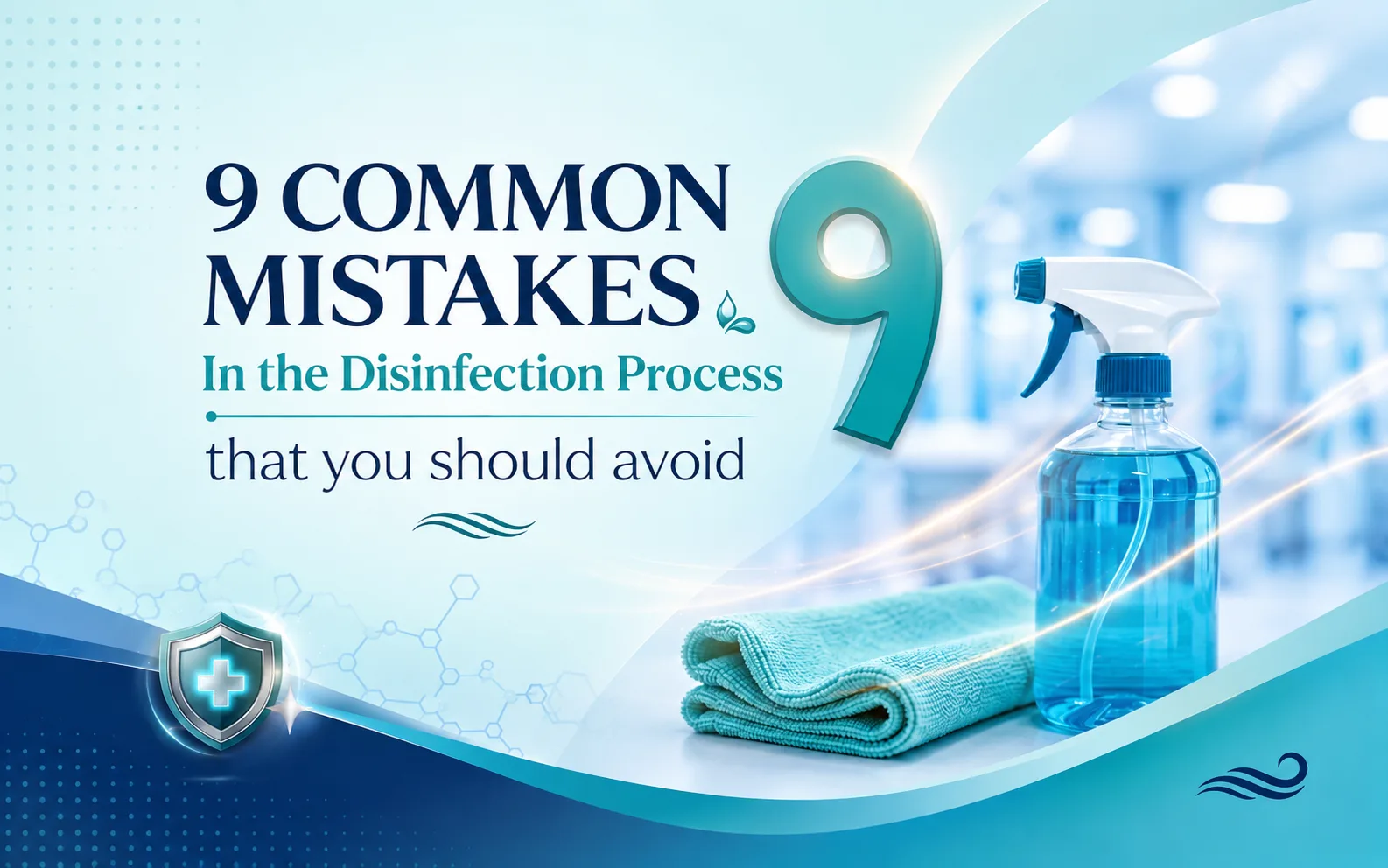
9 Common Disinfection Mistakes to Avoid
Proper disinfection is one of the key pillars of infection prevention and control, as well as biosafety. To ensure protection against pathogens and potentially hazardous chemicals, it is essential to avoid the following common disinfection mistakes during the disinfection process.
1. Choosing the Wrong Disinfectant
Choosing a disinfectant that is specifically designed to eliminate the target type of pathogen is extremely important. Different disinfectants are formulated for different applications, such as human healthcare, veterinary facilities, the food industry, and others.
The intended purpose of the product and its suitability for the actual need should be clearly established. Furthermore, compliance with industry requirements and regulations, as well as selecting a product with a label appropriate for the intended application, should always be a priority.
2. The Misconception That All Disinfectants Are Harmful
Many disinfectants can pose safety hazards; however, this does not mean that all disinfectants are harmful to humans, animals, materials, or the environment.
Some of the most widely used disinfectants are based on potentially hazardous compounds, such as chlorine-releasing agents, quaternary ammonium compounds (QACs), and alcohols. Many of these can cause permanent damage to the eyes and skin and, over the long term, may also be associated with occupational asthma.
In contrast, safer disinfection technologies are available that are formulated with natural and biodegradable substances. These materials are not irritating to the eyes, do not cause corrosive damage to the skin, are not carcinogenic, do not cause respiratory irritation, and do not require special ventilation. These alternatives make everyday use safer.
In addition, the product Safety Data Sheet (SDS) should always be consulted. This document, which is required for every chemical substance present in the workplace, provides guidance on safe handling, the need for personal protective equipment, first-aid measures, and other relevant information. It can also help determine whether an alternative product should be considered.
3. Understanding Cleaning, Sanitizing, Disinfecting, and Sterilizing
Understanding the differences between these processes is essential for effective infection control:
Cleaning: The use of detergents and surfactants to remove dirt and visible contamination from a surface. This step is a prerequisite for disinfection.
Sanitizing: Reducing the microbial load by at least 99.9%. This process brings the number of bacteria on a surface down to an acceptable level; however, its effectiveness against viruses and fungi is not guaranteed. This process is less stringent than complete disinfection, but it still plays a role in reducing the risk of infection transmission.
Disinfecting: The use of chemicals to destroy or inactivate pathogens on a surface, with effectiveness against bacteria, viruses, and fungi. Disinfectants are designed to target and destroy most disease-causing microorganisms in order to achieve a higher level of safety.
Sterilizing: The highest level of reprocessing, intended for critical medical equipment and instruments that come into contact with sterile body tissues. The outcome of this process is the destruction of all forms of microbial life, including spores.
4. Failing to Observe the Required Contact Time
No disinfectant produces sufficient immediate action the moment it comes into contact with a surface. To effectively eliminate pathogens, the product must remain on the surface in a wet condition for a specified period known as the contact time.
If the solution evaporates or dries before the required time has elapsed, it may not achieve sufficient efficacy. Therefore, the product label should always be checked for the required contact time. Preferably, a product with a fast and realistic contact time should be selected to maintain both efficacy and operational compliance.
Staff should also be aware of how long the product needs to remain on the surface.
5. Wiping the Surface Immediately After Spraying
If the surface is wiped immediately after spraying, the disinfectant does not have enough time to work because no product acts instantaneously.
The contact-time instructions stated on the product label must be followed to determine how long the surface should remain wet. The product must remain on the surface for the entire required period before it is wiped away or allowed to dry naturally.
6. Inadequate Surface Cleaning Before Disinfection
Cleaning means the physical removal of foreign and organic matter from a surface; it does not mean eliminating microorganisms. This is achieved using water, detergent, and mechanical action.
The more contamination and pathogens that are removed during the cleaning stage, the greater the likelihood of successful disinfection.
The use of approved one-step cleaner-disinfectants is recommended. These products not only remove visible contamination but also eliminate a significant portion of the pathogens present on the surface.
The term “one-step cleaner-disinfectant” is used by regulatory organizations such as the EPA and Health Canada for products that have been tested under conditions involving organic load and still retain their ability to eliminate pathogens.
Disinfectant formulations that are not registered as one-step cleaner-disinfectants should not be used for the cleaning stage.
7. Mixing Cleaning Chemicals With One Another
Adding any substance to a disinfectant that is not listed on the label or recommended by the manufacturer can be dangerous and may affect the product’s efficacy.
These substances include other cleaning or disinfecting products, fragrances or essential oils, pigments, and any other material that is not specified in the product-label instructions.
8. Inaccurate Measurement of Concentration
When diluting and using concentrated disinfectants, the instructions provided on the product label must always be followed carefully.
A common mistake is using less than the required amount, either because of inaccurate measurement or because of the assumption that using less product will result in financial savings.
This can make the product so weak that it no longer provides sufficient efficacy, thereby increasing the risk posed by pathogens.
Conversely, using an excessive concentration based on the belief that “more concentrated means more effective” is also dangerous and can be harmful to the user, people present in the environment, and the surfaces being treated.
The best way to achieve the correct dilution ratio is to use automatic mixing stations and validated dilution equipment. Concentration test strips are also useful tools for users who manually dilute solutions.
9. Using an Expired Disinfectant
Whether using disinfectant wipes, ready-to-use formulations, or concentrated solutions, checking the expiration date stated on the label is extremely important.
In addition to the product's shelf life in its original form, the stability period of the solution after dilution should also be established.
This period can vary depending on the product. Some solutions remain stable for only 24 hours, some for up to 7 days, and others for as long as 90 days after dilution.
The product label should always be reviewed. If there is any uncertainty, the manufacturer should be consulted to ensure that the usable period of the diluted solution is correctly determined.
Conclusion
Avoiding these common disinfection mistakes is essential for maintaining effective disinfection practices, supporting infection prevention and control, and promoting safe handling of disinfectants. Proper product selection, adequate cleaning, correct concentration, appropriate contact time, and adherence to product-label instructions all play an important role in achieving effective and safe disinfection.
Original Source: Virox Technologies Inc., “9 Common Disinfection Mistakes.”